A conveyor is not dangerous because it is complicated. It is dangerous at a few points where a moving part can reach a hand, and those points are easy to guard.
A walk-through for your plant, in this order:
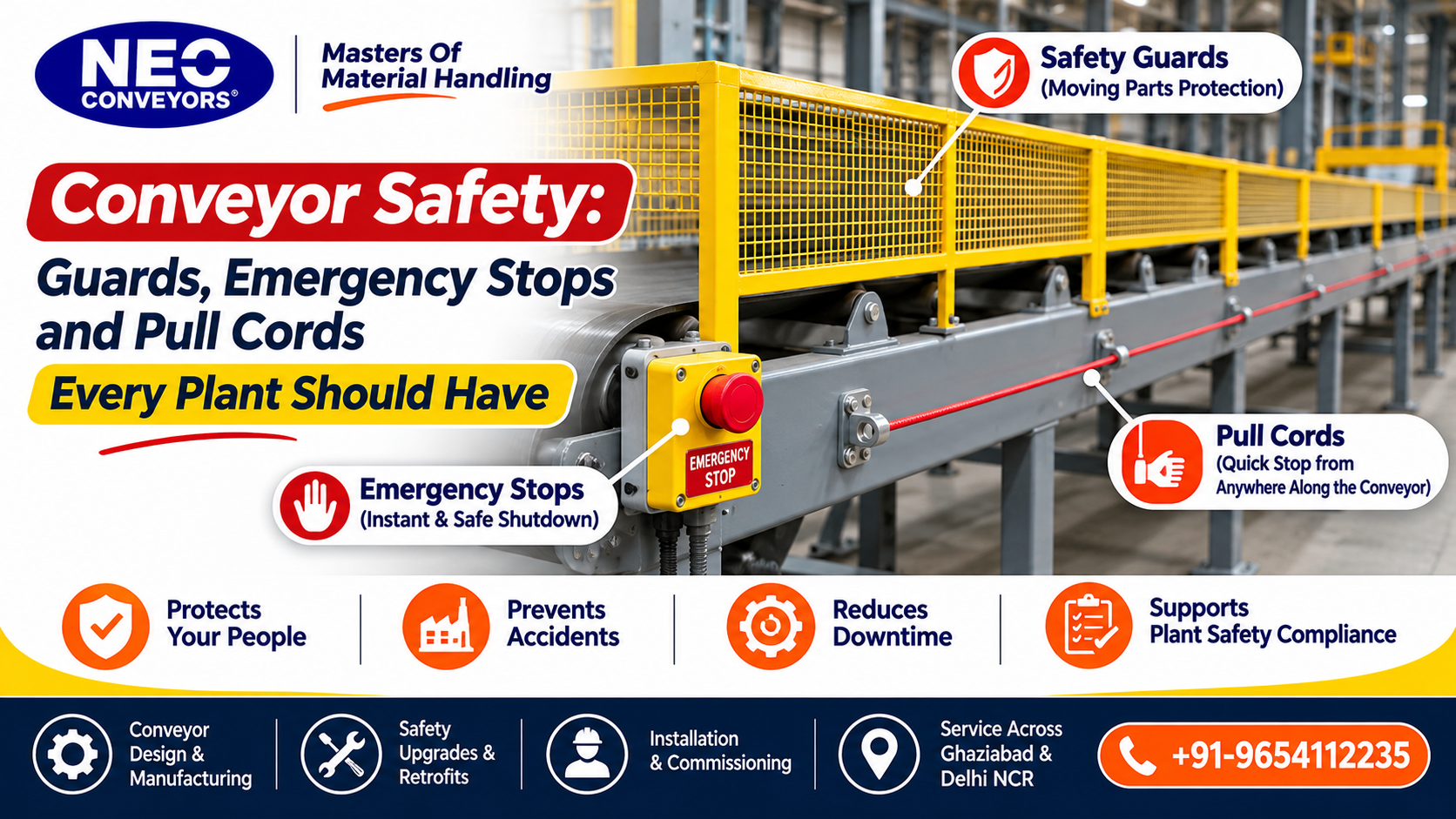
Guards. Fixed guards over the head and tail pulleys, the drive, couplings and chains. Anywhere a belt runs onto a pulley or roller, a hand can be pulled in. A guard that comes off without a tool will end up off.
Emergency stops. A stop button at the drive and at each loading point. It should latch, and the conveyor should not restart until someone resets it by hand.
Pull cords. Along the full length wherever people can walk beside the conveyor, reachable from both sides. Keep the cord tight. A sagging cord is hard to grab.
Lockout. An isolator that takes a padlock, and a rule that nobody works on a conveyor without locking it out. Never clean or clear a running belt.
Crossings. A gate or crossover wherever people have to get across.
Start-up warning. On a long conveyor, a horn or light before it starts.
Then test it all. Press every stop and pull every cord on a schedule and write down the result. A stop that has not been tested is a guess.
Your site rules and local regulations apply, and your safety officer has the final word.
Send us photos of your conveyor, ours or anyone else’s, and we will tell you what we would add.
Call or WhatsApp +91-9654112235
G-414, UPSIDC Phase-II, Ghaziabad
www.neoconveyors.com
conveyor safety guards emergency stop
conveyor pull cord emergency stop
conveyor guarding requirements India
conveyor lockout tagout
conveyor safety checklist
belt conveyor safety Ghaziabad
conveyor safety for plants
Keywords