A stopped wire mesh conveyor is not automatically a failed motor. By separating a blockage, mechanical transmission failure, electrical trip, and process-related fault, you can make the conveyor safe, identify the likely cause, and give a repair team useful evidence instead of a vague breakdown report.
Key takeaways
- Apply lockout/tagout before inspecting the conveyor.
- Clear the wire mesh conveyor blockage before testing the motor.
- Check tracking, tension, sprockets, chains and bearings together.
- Use fault codes and site conditions to choose the repair.
Make the conveyor safe and record the first three observations
Stop product feed and isolate the conveyor before inspecting it. Open the electrical isolator, shut off pneumatic energy if fitted, apply lockout/tagout, and prevent anyone from restarting the machine.
Never clear a wire mesh conveyor blockage by hand or by repeatedly jogging the drive; exposed sprockets, chains, couplings and nip points can pull in clothing or fingers.
Record these three observations without reaching into the guarded area:
- Does the motor run?
- Does the drive shaft rotate?
- Does the wire belt advance?
A motor that runs while the shaft remains still points to a failed coupling, gearbox, key or chain. A rotating shaft with a stationary belt points to sprocket disengagement, a broken or jumped belt, or a jam at the transfer, discharge, scraper, guide or return section.
Photograph the obstruction or damaged part after isolation, then record the load, product, belt temperature, motor current, fault code, obstruction location, tracking direction, and whether the stop occurred during startup or after warming up. These details distinguish a repeatable overload or thermal trip from an intermittent alignment or blockage fault.
If guards were removed, refit and secure every guard before testing or returning the conveyor to production.
Find the blockage before blaming the motor
A stationary belt does not prove a failed motor: compare motor operation, drive-shaft rotation and belt movement, then inspect for a wire mesh conveyor blockage.
1. Stop product feed and observe from a safe position. Note whether the motor runs, whether the drive shaft rotates, and whether the wire belt advances. Do not reach into the conveyor, repeatedly jog it, or remove a guard while energy remains connected.
2. If the motor runs but the drive shaft stays still, inspect the coupling, gearbox output, shaft key and drive chain. This pattern indicates a broken drive path rather than a jam at the belt.
3. If the shaft rotates but the belt remains stationary, inspect the sprocket pockets and belt engagement. A broken belt, jumped sprocket engagement, failed drive chain or jam can produce this result.
4. Check the transfer, discharge chute, scraper, side guides and return path. Look underneath the carrying surface, at return rollers and around sprocket teeth; product wedged between mesh and sprocket, packed material, a bent cross-rod, seized bearing or foreign object can lock the belt.
5. Refit every guard before testing. Exposed chains, sprockets, couplings and nip points can catch clothing or hands.
A motor that trips immediately under load supports a jam or seized component; a silent motor with no trip points toward electrical control or supply failure. Record the obstruction’s location and whether the stop occurred at startup or after warming up.
Check tracking, tension and every part of the drive path
A belt that stops, slips or runs hot can have a sound motor and a failed drive path. Inspect the transfer, discharge, scraper and return sections, then follow the load through the belt, sprockets, shafts, chain, gearbox and bearings.
Material packed between mesh and sprocket, a bent cross-rod or buildup on the drive shaft can stall the conveyor.
- Compare belt temperature with the drive shaft, gearbox and bearing housings. A seized bearing, dry chain, misaligned sprocket or failing gearbox can create heat away from the motor.
- Check both take-ups and adjust them equally. Too little tension lets the belt jump sprocket teeth or rub the frame; too much overloads bearings, shafts, sprockets and mesh.
- Verify that drive and tail shafts are parallel, sprockets sit in line, the frame is square and neither shaft is bent. Check for loose mesh, damaged edges, debris on sprocket teeth and side-frame rubbing.
- Do not correct sideways walking by tightening only the side toward which the belt drifts. That temporary fix can accelerate sprocket and mesh wear.
| Symptom | Mechanical checks | Likely consequence |
|---|---|---|
| Belt slips under load | Tension, sprocket engagement, chain and gearbox torque | Jumped teeth or stalled belt |
| Belt walks sideways | Shaft parallelism, equal take-up and frame squareness | Edge damage and rubbing |
| Drive runs hot | Bearings, chain, gearbox and shaft buildup | Seizure or overload |
| Stops after warming | Bearing temperature, belt temperature and load | Thermal drag or expansion |
For recurring wire mesh conveyor problems in Ghaziabad, record the load, product, temperatures, motor current, obstruction location and tracking direction. Note whether failure occurs at startup or after warming; that separates overload from alignment trouble.
Use fault codes and site conditions to isolate electrical and process failures
A motor that hums, trips, or stays silent does not prove motor failure: compare the fault code and timing with physical resistance.
An immediate overload or VFD trip points first to a jam, seized bearing, tight belt, or gearbox problem; missing phase, low voltage, a loose terminal, open emergency-stop circuit, failed interlock, or incorrect overload setting points to the electrical side. Stop repeated resets.
1. Record the fault code, motor current, incoming voltage, load, product, belt temperature, and whether the failure occurred at startup or after warming up. A trip after heating suggests overload, poor cooling, or a failing motor; an instant trip suggests obstruction or a short circuit.
2. With energy isolated, check whether the belt and shafts turn freely. Then inspect the motor terminals, phase balance, overload setting, VFD fault history, gearbox, bearings, and cooling passages.
3. Treat dust as a mechanical and thermal clue. Dust entering bearings or chain drives increases drag, while dust packed into motor cooling passages raises temperature and triggers a thermal trip. Remove dry dust without directing compressed air into sealed bearings.
4. Treat water and chemicals as electrical and corrosion clues. High-pressure water can force contamination past bearing seals or damage connectors, sensors, and VFD components; chemical residue can corrode mesh, terminals, insulation, and seals. Record the washdown method and chemical used.
For recurring wire mesh conveyor problems in Ghaziabad warehouses, these readings separate a repeatable overload from an intermittent supply, alignment, or environmental fault. Never energise the conveyor to test a suspected jam.
Choose the repair from evidence, not from horsepower alone
Give the repair provider evidence, not just the motor’s horsepower. If your search reads “wire mesh conveyor for stops working in Ghaziabad”, include photographs and measurements that show where the failure occurred.
- Conveyor length, belt width, mesh pitch, wire diameter and belt material
- Motor nameplate data, gearbox ratio, output speed and drive arrangement
- Loaded product weight, belt speed, operating temperature and duty cycle
- Whether the motor runs, trips, stays silent or turns the gearbox without moving the belt
- Noise or heat readings from the motor, gearbox, bearings, drive chain and belt
- The jam location, damaged parts, washdown chemicals, dust exposure and recent changes
For wire mesh conveyor repair in Ghaziabad, match a replacement belt section to the original pitch, wire diameter, material and edge construction. A wire tie or mismatched mesh creates a raised snag, damages products, catches scrapers or fails across the sprocket.
| Repair | Replace matched part | Redesign |
|---|---|---|
| Local damage with correct belt specification available | Broken mesh, sprocket, bearing or chain | Repeated failure after correct parts and alignment |
| Existing frame and load remain suitable | Motor or gearbox selected by speed, torque, shaft arrangement, mounting and service factor | Loaded starts exceed drive capacity or the belt speed is unsafe |
| One-off obstruction or worn component | Fit the original specification | Product buildup, washdown, heat or dust exceeds the present design |
Neo Conveyors can use these operating details to distinguish a part failure from a design mismatch before fabrication begins.
Related product
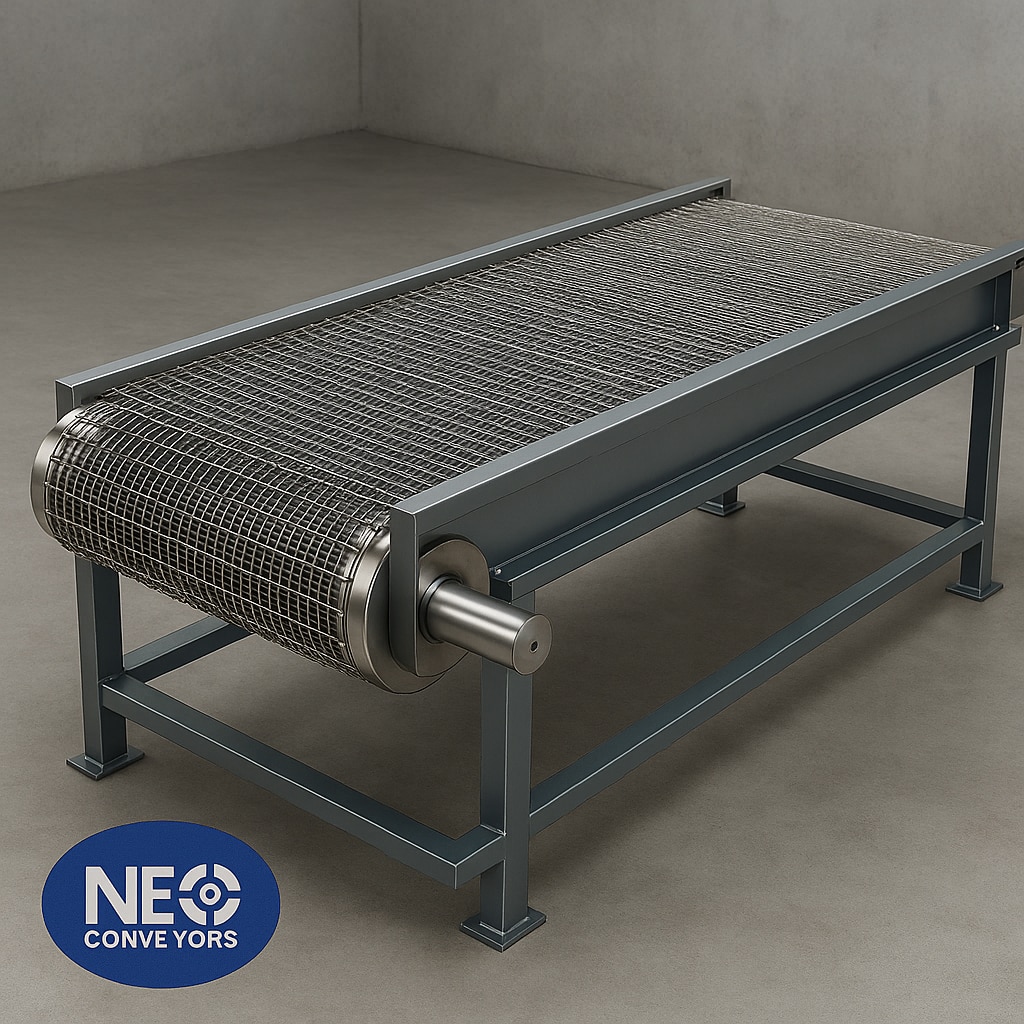 | Wire Mesh Conveyor Stainless Steel Wire Mesh Belt Conveyor The Wire Mesh Conveyor from Neo Conveyors is designed for efficient handling of products in applications... View product → |
Frequently asked questions
What should you do first when a wire mesh conveyor stops working in Ghaziabad?
Stop product feed, open the electrical isolator, shut off pneumatic energy if fitted, apply lockout/tagout, and prevent restart before inspection.
How do you find a wire mesh conveyor blockage?
Inspect the infeed, transfer points, discharge and return path for trapped product, belt damage, misalignment or material packed around sprockets and rollers.
Which drive parts should you check during a warehouse conveyor breakdown?
Check wire mesh tracking, chain tension, sprockets, drive and tail shafts, bearings, couplings, gearbox oil and the motor brake.
How can fault codes and site conditions identify the cause?
Record the drive fault code, motor current, emergency-stop status and sensor condition, then compare them with product buildup, washdown, heat, dust and overloading.
Keywords