A courier hub does not choose between mesh and rollers by belt material alone. Parcel shape, smallest item, scan rate, transfer geometry, accumulation method and cleaning workload determine whether wire mesh improves flow or creates new jams; the sections below give you a practical way to compare systems and specify an acceptance test.
Key takeaways
- Use wire mesh for polybags, soft parcels and irregular shapes.
- Use rollers for rigid cartons with a flat, stable base.
- Specify mesh opening, belt speed, transfers and accumulation zones.
- Test the complete line with peak-size and peak-weight parcels.
Wire Mesh Belt Versus Roller: Which Parcel Flow Does Each Handle Better?
For mixed courier parcels, a wire mesh belt usually carries soft, flexible and irregular items more reliably, while rollers suit rigid cartons with a stable, flat base. The belt supports the parcel continuously; rollers support it at contact points, so polybags can sag, skew or bridge gaps.
| Option | Parcel-flow strength | Main limitation |
|---|---|---|
| Wire mesh belt | Continuous support for polybags, padded envelopes, irregular cartons, totes and unstable loads; steady movement past scanners | Small envelopes, straps, labels or loose film can catch in openings; cleaning, tracking and mesh replacement add work |
| Powered rollers | Rigid cartons, controlled spacing and powered accumulation; lower-friction surfaces help manual diverting | Limp sacks can deform between rollers; close pitch, side guides or belt-over-roller sections may be needed |
| Free rollers | Simple gravity movement for rigid cartons and manual handling | Poor control of polybags and irregular parcels; parcels can stop, skew or collide without powered zones |
Treat transport, accumulation and sortation as separate decisions. A moving mesh belt is not a zero-pressure queue: stopped parcels can rub, rotate, overlap or wedge against guides. Powered-zone rollers are better for contact-free accumulation, while pop-up wheels, sliding shoes or cross-belt equipment handle dedicated diverting tasks.
Scanning works with either conveyor when parcels remain stable and labels face the scanner. Rollers are quieter at low speeds and easier to access, but a complete system with drives, controls, guarding and transfers can cost more than its frame suggests.
This unique wire mesh conveyor comparison for courier hubs in ghaziabad should therefore assess the entire line, not just the surface. The wire mesh conveyor comparison courier hubs require must include throughput under the actual parcel mix.
Match the Conveyor Surface to the Parcel and the Hub Zone
A wire mesh conveyor suits transport when parcels need continuous support rather than contact with separate rollers. That makes it useful for soft polybags, padded envelopes and irregular cartons, but only after the mesh opening and transfer gap have been checked against the smallest item.
A useful wire mesh conveyor comparison courier hubs must also separate transport from accumulation and sortation.
| Parcel type | Wire mesh suitability | Better alternative or control |
|---|---|---|
| Cartons | Good for uneven bases and mixed shapes; verify that corners cannot enter the openings | Powered rollers for flat-bottomed cartons that need manual diverting |
| Polybags | Good support reduces sagging and twisting; straps, tape and labels can snag | Solid belt for very small or loose polybags |
| Envelopes | Suitable only with fine mesh, a supported edge and a gap-free transfer | Narrow solid belt when envelopes can fold or catch |
| Totes | Suitable when the tote has a rigid, flat base | Powered-zone rollers for queuing and contact-free accumulation |
| Irregular packages | Good continuous support for unstable shapes | Solid belt or guided carrier when protrusions can hook the mesh |
Do not stop parcels on a moving mesh belt to create a queue: rubbing, rotation and wedging follow. Use powered zero-pressure rollers for accumulation, and select pop-up wheels, sliding shoes or a dedicated sorter for diverting.
Mesh helps where drainage, airflow or wash-down matters, but packed tape and film fragments remove that advantage, so provide inspection and clean-out access.
Specify Mesh, Speed, Transfers and Accumulation Before You Request a Quote
A quote needs more than nominal belt width. Provide the longest, widest and tallest parcel, mass range, smallest item, bottom condition, deformable packaging, expected parcels per hour, peak rate, incline and required accumulation length.
- State mesh opening, wire diameter, belt edge construction and support method against the smallest envelope, strap, label or polybag. An opening that catches loose packaging creates snags; a coarse surface can rock a tall carton.
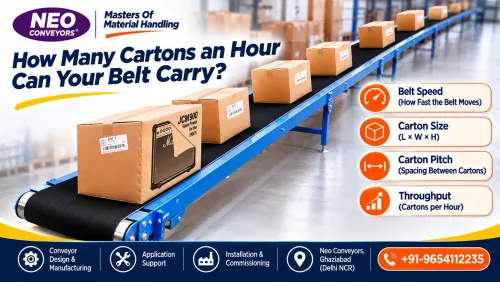
- Give the target rate and available pitch, or parcel-to-parcel spacing. Estimate belt speed with v = Qp/3600 metres per second, where Q is parcels per hour and p is metres per parcel. Check that speed against barcode-camera exposure time and scan spacing.
- Draw every transfer with nose-to-nose gap, height difference, transfer orientation, belt-to-roller speed difference and side-guide clearance. A small gap can trap a polybag; a high lip can tip a carton; a pinched guide can stop the line.
- Define accumulation as transport plus a separate function: specify zero-pressure zones, zone length, release logic, stop-and-restart rate and maximum dwell time. Do not assume a mesh belt alone provides accumulation or sortation.
| Requirement | State this in the specification | Failure prevented |
|---|---|---|
| Mesh | Opening, wire diameter, edge and smallest parcel | Snags and dropped small items |
| Flow | Average rate, peak rate, pitch and scan exposure | Missed reads and impact damage |
| Transfers | Gap, height, orientation, speeds and guides | Tipping and pinch jams |
| Accumulation | Zone type, length, controls and restart rate | Back-pressure pile-ups |
| Conveyor geometry | Width, incline, mass range and bottom condition | Belt overload and unstable parcels |
Test the Complete Line Under Peak Parcel Conditions
A no-load demonstration proves almost nothing about hub performance. Build the trial with representative peak-load parcels, including the smallest envelope, deformable polybag, heaviest carton, tote and irregular package expected in production.
Run the complete line through these conditions:
- Feed parcels at the planned sustained rate, then at the peak parcels-per-hour rate. Record belt speed, spacing, accumulation length and motor behaviour.
- Pass every barcode format through the actual scanners. Record missed reads, duplicate reads, camera exposure problems and parcels that arrive outside the scan window.
- Send parcels across every transfer. Check nose-to-nose gaps, height changes, belt-to-roller speed differences, side-guide pinch points, rocking and stalled packages.
- Command each divert repeatedly with mixed parcel sizes. Record wrong-lane diversions, failed transfers, impacts, snags and damage.
- Run with parcels on the line, apply a controlled stop, then restart. Check whether packages shift, fall, bunch together or resume at the intended spacing.
- Test the emergency stop and record stopping distance, response time, alarm behaviour and restart sequence.
- Inspect belt tracking, mesh edges, sprocket engagement and frame contact while measuring operating noise in dB(A).
Repeat the trial long enough to expose heat, contamination and accumulation effects rather than accepting one successful pass. Put numerical acceptance limits in writing for throughput, missed scans, jams, damage, noise and restart recovery before the supplier tests the line; otherwise a pass becomes a matter of opinion.
Turn “Unique” Into a Measurable Courier-Hub Specification
Ask the courier conveyor supplier in Ghaziabad for acceptance criteria written as numbers, not a claim that the design is “unique.” A unique conveyor for logistics hubs is a configuration proven against your smallest parcel, peak flow and actual transfer problems.
1. Submit a signed design schedule covering parcel length, width, height, mass range, bottom condition, smallest item, peak parcels per hour, belt speed, incline, transfer orientation and accumulation length. Require the mesh opening, wire diameter, edge construction, guide spacing and motor rating to be tied to those values.
2. Demonstrate the complete line with representative peak-load parcels: cartons, polybags, padded envelopes, totes and irregular packages. Record sustained throughput, missed scans, jams, tipping, damage, belt tracking, noise, merge performance and restart behaviour after a controlled stop.
3. Prove every claimed difference. Specify the smallest parcel that cannot snag, the transfer gap limit, clean-out access time, belt-section replacement time, barcode-reader position, weigh-and-dimensioning accuracy and merge-control response. Do not accept an unusual frame shape as evidence of uniqueness.
4. Separate transport from accumulation and sortation in the quotation. Identify whether accumulation uses zero-pressure zones and whether diverting uses pop-up wheels, sliding shoes, cross-belt modules or another system; test each with your parcels at peak rate.
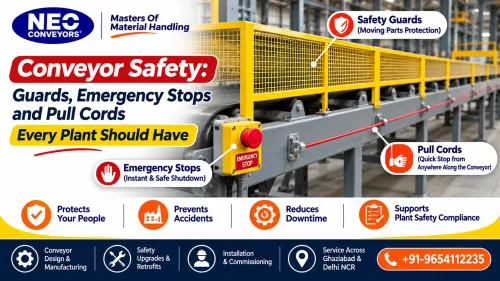
5. Inspect guards at sprockets, return strands, drives, nips and transfers. Record emergency-stop stopping distance and restart controls against ISO 12100, ISO 13849-1 and ISO 14120 before installation.
Neo Conveyors should be asked to provide this same evidence in the factory and site acceptance records, rather than relying on an empty-belt demonstration.
Related product
 | Wire Mesh Conveyor Stainless Steel Wire Mesh Belt Conveyor The Wire Mesh Conveyor from Neo Conveyors is designed for efficient handling of products in applications... View product → |
Frequently asked questions
Which handles mixed courier parcels better: a wire mesh belt or rollers?
A wire mesh belt usually handles soft, flexible and irregular parcels better because it supports the full parcel surface. Rollers suit rigid cartons with a flat, stable base.
How should you match a conveyor surface to each courier-hub zone?
Use continuous wire mesh support where polybags, soft packs or irregular parcels can sag or skew. Use rollers for stable cartons and zones that need controlled accumulation.
What should you specify before requesting a conveyor quote?
Provide parcel dimensions and weights, mesh opening, belt speed, transfer gaps, accumulation requirements and the operating conditions for each zone.
Why test the complete conveyor line under peak parcel conditions?
Peak-condition testing reveals skewing, bridging, transfer failures, belt tracking problems and accumulation limits that a single-parcel trial can miss.
Keywords