Choosing a wire mesh conveyor starts with the product, process duty and cleaning regime—not the belt width alone. You will be able to compare belt constructions, mesh openings, stainless steel grades and alternative conveyor types, then write a specification that can be tested under actual plant conditions.
Key takeaways
- Match balanced, compound balanced or welded mesh to the process duty.
- Select openings that support products without trapping or dropping them.
- Specify stainless steel grade against cleaning chemicals, moisture and operating exposure.
- Confirm belt performance with product trials, site measurements and loading checks.
Match the wire mesh construction to the process duty
A belt construction must follow the process duty, not just the product weight. Straight conveying suits balanced weave for general loads; compound balanced weave gives smaller openings, smoother support and higher stability for small, delicate or irregular products. Welded wire mesh suits rigid products, washing, draining and applications needing open, easy-to-clean surfaces.
Inclines need positive tracking, adequate friction and flights or side guards when products slide.
| Belt construction | Best fit | Main limitation |
|---|---|---|
| Balanced weave | General conveying, cooling and drying; medium-sized products | Small products can catch in larger openings |
| Compound balanced weave | Small parts, fragile goods, heavy loads and longer routes | Higher cost and more difficult cleaning between fine wires |
| Welded wire mesh | Washing, draining, fryer or oven service, rigid products | Welds and edges need inspection for snags and product marking |
A description such as “neo conveyors wire mesh belt” is incomplete without wire diameter, pitch, opening size, width, edge finish, material grade and drive method. Two belts with the same width can have different load capacity, open area and tracking behaviour.
For wire mesh conveyor options for plants, specify these route conditions before comparing quotations:
- Product dimensions, shape, weight and load per metre
- Conveyor length, incline or decline angle, speed and transfer gaps
- Operating temperature, peak temperature and heating or cooling rate
- Cleaning method, washdown chemicals and required drainage
- Drive location, belt return access, side guards and accumulation points
Open mesh does not guarantee hygienic operation. Choose drainable frames, accessible returns, sealed cleanable bearings and no hollow sections that retain wash water. A high-temperature belt also needs temperature-rated bearings, lubricant, motor, sensors and guards.
Choose mesh openings that retain, support and release the product
Opening size determines whether a product rides securely, drains cleanly or disappears through the belt. Select it against the smallest product dimension, not the nominal belt width: an opening larger than a part’s foot, edge or corner creates entrapment and product loss.
Wire mesh conveyor options for plants should be compared by the handling result each opening delivers:
| Opening choice | Handling effect | Main risk |
|---|---|---|
| Small opening | Supports small, irregular or fragile parts and reduces product loss | Less drainage, airflow and heat transfer; debris can clog the belt |
| Medium opening | Balances product support with cooling, washing and drainage | Products can tip if their base is narrow |
| Large opening | Maximises air circulation, liquid drainage and heat transfer | Small parts, pointed edges or loose debris can fall through or catch |
A larger opening is not automatically better for a fryer, washer or cooling line. Check the product’s smallest footprint, allowable marking, liquid carryover and the size of waste that must pass through. A small opening can protect the product while restricting wash water and extending drying time.
Belt features decide whether the opening performs consistently. Specify cross-rod spacing, wire diameter, smooth or reinforced edges, welded or rounded selvage, and the smallest transfer gap. A rough edge can scratch packaging; a wide gap can catch product even when the mesh opening is correct.
Ask for a loaded trial at target speed. Watch for tipping, wedging, marking, carryover and product loss at transfers, inclines and accumulation points. An unloaded belt will not reveal those failures.
Specify stainless steel grade for the cleaning and exposure conditions
Choose SS 304 for dry conveying, routine washdown and general food or industrial service where chlorides are controlled. Choose SS 316 when salt, brine, saline wash water or aggressive chemical cleaning creates a higher risk of pitting corrosion.
| Grade | Cleaning and exposure | Practical choice |
|---|---|---|
| SS 304 | Dry service, mild detergent, fresh-water washdown and limited standing water | Lower-cost general-purpose grade |
| SS 316 | Chloride-bearing water, salt products, frequent wet washdown or harsher chemical exposure | Better resistance to chloride pitting |
| SS 316L | The same exposure as 316, with extensive welded fabrication | Preferable where reduced weld-carbon precipitation matters |
For a stainless steel conveyor in Ghaziabad, record the actual cleaning regime rather than specifying “stainless” alone. State detergent concentration, sanitizer chemistry, water temperature, washdown frequency, measured chloride content and whether water remains on the belt or frame.
A line exposed to monsoon ingress, pooling or poor drainage needs more attention than a dry indoor conveyor.
SS 316 is not corrosion-proof. Surface contamination from carbon-steel tools, weld discoloration, tight crevices and stagnant liquid can still cause failure. Specify pickled or passivated welds, smooth drainable frames and a finish that does not trap residue. Do not select 316 solely because cleaning is frequent; confirm chemical compatibility at the actual concentration and temperature.
Turn the process into a complete conveyor specification
A quotation is only comparable when it states the duty, route and operating limits. Start with the product’s length, width, height, weight, shape, loading pattern and required throughput; then define belt construction, frame, drive and site constraints.
| Duty | Conveyor type to compare | Details to specify |
|---|---|---|
| Straight conveying | Balanced weave or welded wire mesh | Belt width, length, product support, transfer gaps and load per metre |
| Incline or decline | Positive-drive belt with flights, cleats or side guards | Angle, product slip risk, elevation change and discharge height |
| Cooling or drying | Open mesh belt with airflow clearance | Air temperature, residence time, airflow direction and belt speed |
| Oven, fryer or quench | Heat-rated balanced or compound balanced weave | Continuous and peak temperature, heating rate, cooling rate and thermal expansion |
| Washing or draining | Open stainless mesh with washable frame | Drainage slope, standing-water exposure, detergent, sanitizer, chloride level and wash frequency |
| Accumulation | Reinforced belt and controlled drive | Back-pressure limits, accumulation length, sensor positions and motor torque |
State wire diameter, pitch, opening size, belt width, edge finish, material grade and drive method. A “wire mesh conveyor” description leaves two nominally identical belts with different capacity, open area and cleaning behaviour.
For a stainless steel conveyor in Ghaziabad, separate process data from site data. Include electrical supply, floor loading, clearances, drainage, ambient dust, humidity, monsoon water exposure, washdown access and local spares. For oven or fryer service, rate bearings, lubricants, motors, sensors and guards—not just the belt—for the specified temperature.
- Request the guaranteed speed range, load per metre, motor rating, tracking method, guarding, controls and cleaning procedure.
- Ask for a trial using your product, packaging, loading pattern, target speed and wash routine; an unloaded test will not expose tipping, entrapment, drift or inadequate torque.
Use product trials and site checks to confirm the final choice
Run the selected conveyor with your actual product, packaging, loading pattern, target speed and cleaning method before approving it. An unloaded belt can hide product tipping, mesh entrapment, tracking drift, accumulation and inadequate drive torque.
Ask a custom conveyor manufacturer in Ghaziabad to document a factory-acceptance trial with measurable pass criteria:
- Confirm that every product remains stable at the fastest and slowest operating speeds.
- Check transfer gaps, incline sections and discharge points for tipping, jamming and product loss.
- Measure belt tracking, drive motor current, noise, vibration and stopping distance during loaded operation.
- Run the planned washdown or cleaning procedure, then inspect for trapped water, residue and inaccessible surfaces.
- Test accumulation, restart after an emergency stop and operation at the highest specified load.
A search for Neo Conveyors wire mesh conveyor choices for plants in Ghaziabad should lead to a written trial record, not only a catalogue selection. Record belt construction, wire diameter, pitch, opening size, width, edge finish, stainless-steel grade, drive arrangement and tested load in the approval document.
Inspect the proposed installation at the Ghaziabad site before fabrication. Confirm electrical supply, floor loading, drainage, clearances, dust, humidity, monsoon water exposure, washdown access and spare-parts routes. Reject a design with hollow members that retain water, uncleanable ledges, exposed bearings or a return path that operators cannot safely inspect.
Related product
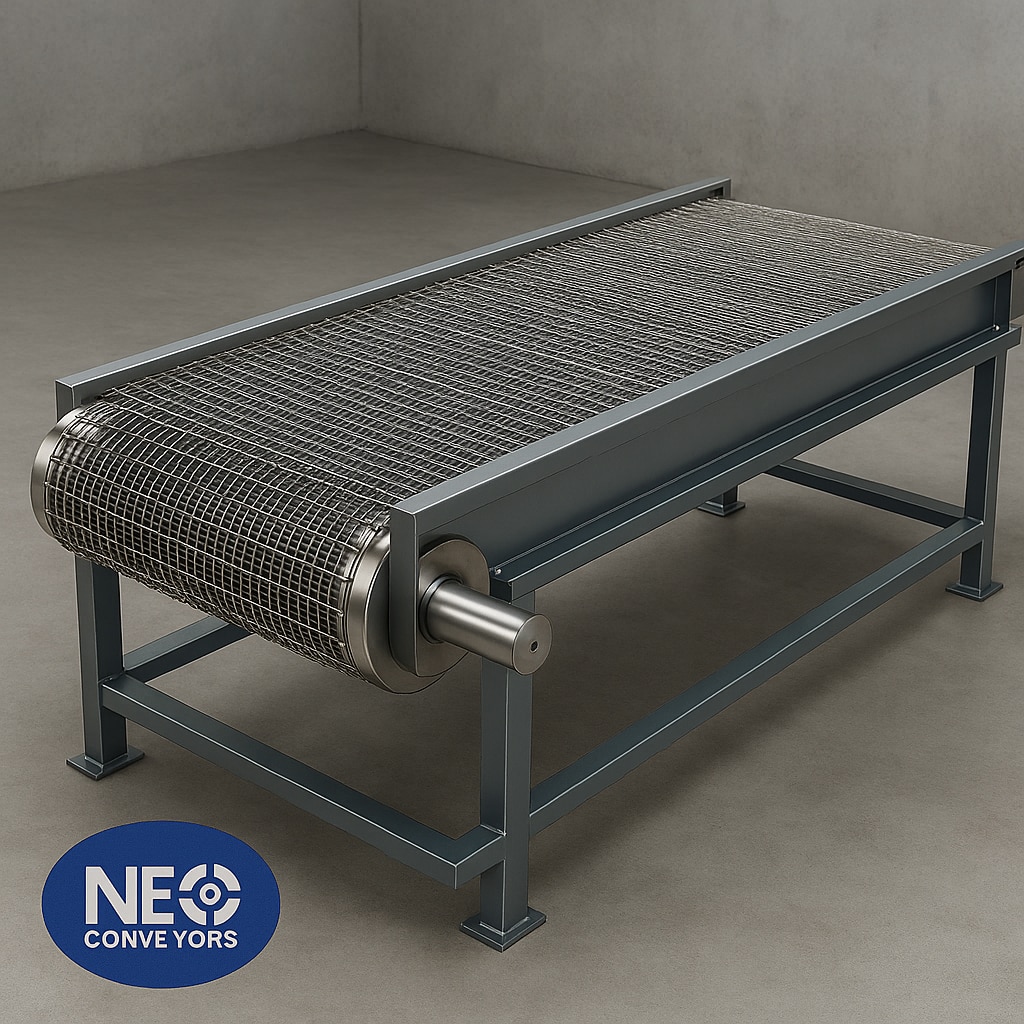 | Wire Mesh Conveyor Stainless Steel Wire Mesh Belt Conveyor The Wire Mesh Conveyor from Neo Conveyors is designed for efficient handling of products in applications... View product → |
Frequently asked questions
Which wire mesh construction suits different conveyor duties?
Use balanced weave for straight conveying and general loads, compound balanced weave for small or delicate products, and welded wire mesh for rigid products, washing and draining.
How do you choose the right wire mesh opening?
Choose an opening that supports the product, retains it during transfer and releases it without trapping edges or causing damage.
How should you specify stainless steel for a wire mesh conveyor?
Specify the stainless steel grade against the cleaning method, chemicals, moisture, temperature and other exposure conditions at the plant.
What should a complete wire mesh conveyor specification include?
Define the process duty, product dimensions and weight, belt construction, mesh opening, stainless steel grade, conveyor layout, operating conditions and cleaning requirements.
Why conduct product trials and site checks before final selection?
Trials reveal product support, release and tracking performance, while site checks confirm available space, transfer points, loading conditions and installation constraints.
Keywords